- Encyclopedia
- Breeds
- Egyptian Ghuzar Pigeon
- Egyptian Homer
Breed
Egyptian Homer
الحمام المراسلة المصري
المراسلة · حمام المراسلة المصري

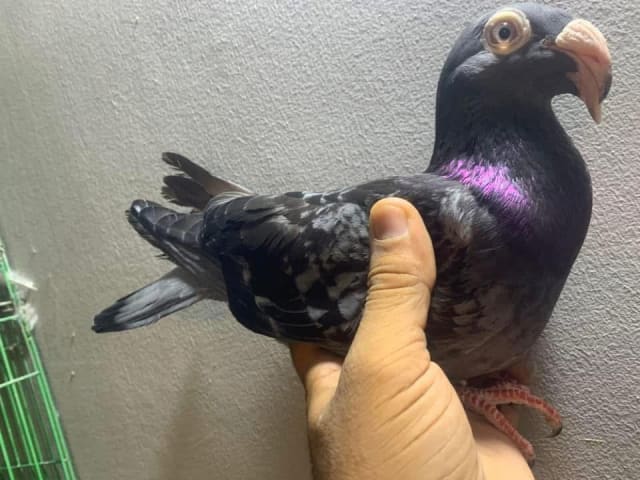
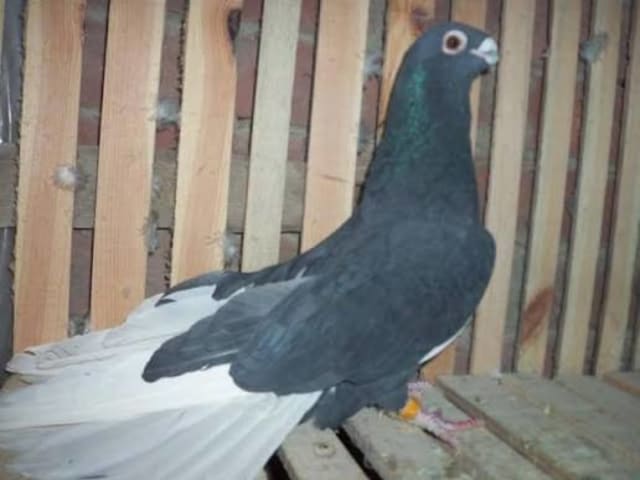
The Egyptian Homer — a long-established Egyptian messenger breed, distinct from the European Racing Homer in both make-up and standard, kept in Egypt for show and ornament alongside its history of carrying messages. Note that it is not one of the Ghuzar houses but a separate Egyptian breed in its own right. Standard: head shaped like a half circle, sloping to the rear; beak long and thick following the curve of the head, in two forms — the round beak, which slopes with the curve of the head, and the khayari beak, which slopes forward. The beak must be white in every colour except the black, where a black tip is required as a mark of purity; the upper mandible is slightly shorter than the lower. Eye round and wide, white banded with a light red — except in the white, whose eye is bakma. Eyelids fine and white. Body strongly built, short in length and broad in the breast, with a distinctive stance: the chest lifted and the tail carried close to the ground. Legs short. The breed divides into foundation houses (white, black, blue/Ezazi, Bidairi and Hamri) and non-foundation ones (Mofassas, Ingilizi, Sabouni and Hadidi).
References
معلومات من كبار مربي الحمام الغزار والمصري وما توفر من المراجع
Sub-breeds

More from this category




Related articles

Patterns and markings: bar, checker, ablaq and masood in Egyptian fancier terms
Colour is one thing and pattern is another. The wing is patterned in four grades, and colour is distributed over the body in patterns whose Egyptian names are decades old.
15 September 2026Planned pairing: how to plan a pair for the colour you want
Genetics is not luck once you keep records. With four rules and a simple table you can predict the squabs' colours before the eggs hatch — and know when to break the rules.
15 September 2026Reading the judging criteria: kantara, wing butts and eye — how Ghuzar is judged
The judging criteria are no secret — they are published on every breed's page with their weights. Here is a guide to the main points and how to see your bird through a judge's eyes before the show.
15 September 2026