
Part two of the colour series — if you missed base colours, start there.
Wing pattern: four grades
On top of the base colour sits the pattern gene that draws the wing, in four grades from lightest to darkest:
- Barless: a clean wing with no lines — the weakest genetically and the rarest.
- Bar (two bars): two dark stripes across the wing — the wild pattern.
- Checker: dark squares over the wing.
- Dark checker (T-pattern): the wing almost covered in dark.
Each grade is dominant over the one before it: checker covers bar, and bar covers barless. A bird carries two copies, so a checker can "carry" bar and produce it in its squabs.
Telling colour from pattern
First question: what is the base colour? (blue/red/brown). Second question: what is the wing pattern? For example: "blue bar", "red checker", "silver bar". Egyptian fanciers often merge the two into one name (izazi is usually blue bar).
Colour distribution over the body — the Egyptian names
These are entirely different genes (white patches / pied), and they give Egyptian pigeons their names:
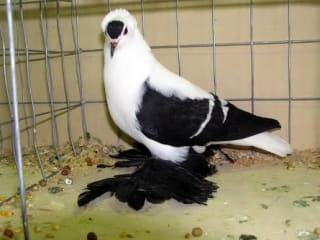
- Ablaq: a white body with colour on the wing butts and cheeks (sometimes the tail). Named by colour: red ablaq, ablaq on charcoal (black), hazelnut ablaq.
- Masood: a dark head or neck with the rest light — masood balaha (a small spot), masood tilteen, masood khanafis.
- Safi: one pure colour over the whole body.
- Mzarzar: irregular patches on white (splash).
- Sukkari: a fine white spray over a coloured ground.
- Magpie: coloured head and tail with a white body — European names that entered the Egyptian vocabulary.
Where beginners get confused
- Ablaq is not a colour — it is a distribution. There is red ablaq, black ablaq and yellow ablaq.
- Black is not a pattern — it is blue with spread; spread hides the wing pattern completely, so you cannot tell by eye whether a black is bar or checker.
- Paper yellow can be dilute recessive red or dilute ash-red — and the two are inherited differently.
How to record your bird's colour on Ghuzar
When you register the bird, write: base colour + wing pattern + distribution if there is one. For example: "blue checker" or "red bar ablaq". Precise descriptions keep the pedigree tree useful generations later — and the next part explains how to plan with it: planned pairing.