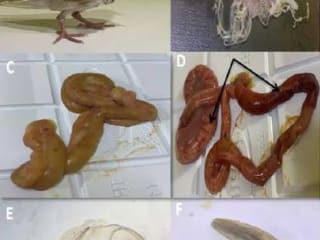
If you open a squab's beak and find yellow, cheesy lumps in the throat or on the roof of the mouth, it is most likely trichomoniasis — what fanciers call "canker". It is the most common disease in Egyptian lofts, and almost every loft carries it to some degree.
⚠️ This article is for awareness only. Any treatment must be prescribed by a vet and given at the dose on the label — there are deliberately no doses here.
What is it?
A single-celled parasite (Trichomonas gallinae) that lives in the mouth, throat and crop. Its encyclopedia page is here, under protozoal diseases. Most adult pigeons carry it without symptoms — the problem is in squabs and stressed birds.
How does it spread?
- From parents to squab with crop milk — the main route.
- Shared drinkers — a bird drinks and leaves the parasite in the water.
- Billing during courtship and food exchange.
- Wild and stray pigeons landing on the roof.
Symptoms
- Yellow or white cheesy lesions in the mouth, throat or beak opening.
- The squab swallows with difficulty, beak open, laboured breathing.
- Foul smell from the beak.
- Weight loss and green diarrhoea in squabs.
- In the "navel" form in young squabs: a swelling at the navel.
- In adults, often nothing except lower performance — a racer arriving late for no clear reason.
Diagnosis
A throat swab with a damp cotton bud, examined under the microscope on the spot by the vet. It is cheap and fast, and it tells canker apart from candidiasis and pigeon pox, which can look similar in the mouth.
Treatment
The vet chooses from the nitroimidazole group (carnidazole, ronidazole or metronidazole) — as a tablet for the affected bird, or in the water for the whole loft.
- Never scrape the yellow lumps off by hand or with a stick — it wounds and bleeds.
- Finish the full course.
- Treat both parents with the squab, or it will be passed straight back.
The "monthly treatment" mistake
Many fanciers give canker medicine every month "just in case". The result: the parasite adapts and the drug stops working when you really need it. The rule most vets follow: swab first, and use preventive treatment only at specific points (before pairing, for example) if the loft has a history of the disease.
Prevention
- Clean the drinker daily — wash it and don't leave it in the sun with warm water.
- No crowding around the water.
- Keep wild pigeons off your roof and away from your drinker.
- Quarantine every new bird, with a swab (see the quarantine story).
- Log every case in the bird's health status in the app — you will learn which pairs pass it on most.
Canker is not a disaster if you handle it right: a swab, targeted treatment, and clean water every day.